
Switzerland is positioned as a leading robotics ecosystem. The report states that Switzerland has created 5x more VC-backed robotics startups per capita since 2020 than the UK, around 6–7x more than Germany, and 3.5x more than the US. This makes robotics one of the clearest areas where Switzerland has a disproportionate global advantage.
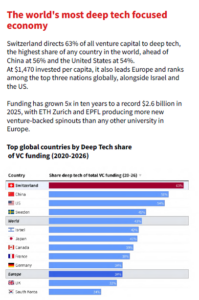
Robotics is becoming one of the fastest-growing Swiss deep tech segments. Among Swiss startups founded since 2022, robotics has nearly doubled its share compared with the 2010–2021 period. The report identifies AI/ML, robotics, and future of compute as the fastest-growing areas of new Swiss startup creation.
The Swiss robotics startup base is already financially significant. The report identifies 45+ VC-backed robotics startups, $1.1B in VC funding since 2020, and $3.8B in combined enterprise value for robotics in Switzerland. Notable domestic startups listed include ANYbotics, Embotech, Flexion, Ecorobotix, and Mimic.
The ecosystem combines research excellence, corporates, and community infrastructure. The report highlights key institutions and labs such as ETH, EPFL, CERN, IDSIA, Idiap, ASL, RSL, SRL, BioRob, LASA, and RPG, alongside corporate activity from actors such as ABB, Boston Dynamics, Sony, Amazon, and Disney Research. It also presents the Swiss Robotics Association, Swiss Robotics Day, ETH Robotics Club, and Zurich Robotics Roundtable as important ecosystem builders.
ETH and EPFL are strategic engines for robotics spinouts. The report ranks ETH Zurich and EPFL Lausanne 1st 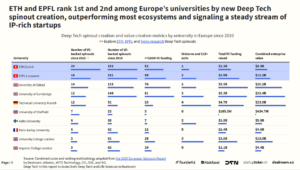 and 2nd in Europe for new deep tech spinout creation since 2010, indicating a strong pipeline of IP-rich startups. This is directly relevant for robotics, where university labs are central to company creation.
Robotics benefits from Switzerland’s broader strengths in AI and compute. The report says Switzerland has the highest density of AI researchers globally, and it positions AI, robotics, and future of compute as mutually reinforcing sectors. For robotics, this matters because next-generation systems increasingly depend on AI, perception, control, edge compute, sensors, and high-precision engineering.
The capital opportunity is now at scale-up stage. Foreign investors provide 88% of funding for Swiss deep tech rounds above $100M, while Swiss investors’ share falls to 12% at late stage. For the robotics community, this suggests that Switzerland has strong research and company formation capacity, but needs larger domestic late-stage tickets to retain more value locally.
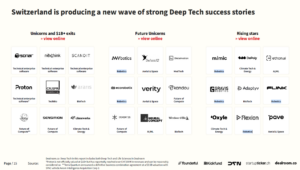
The message for the community is clear: Switzerland should not treat robotics as a niche academic strength, but as one of its strongest deep tech assets. The priority is to connect labs, startups, corporates, investors, students, and national platforms more tightly so that Swiss robotics companies can scale globally while remaining anchored in Switzerland.