
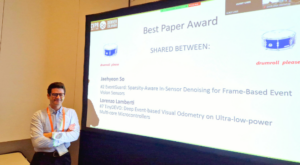
Copied from original article: https://www.supsi.ch/en/percezione-neuromorfica-a-basso-consumo-la-ricerca-supsi-premiata-a-livello-internazionale
Held in Denver (USA) from 3 to 7 June 2026, the Conference is one of the world’s leading scientific events in computer vision, bringing together researchers and professionals each year to present the latest advances in the field.
The award was presented to an international research team that includes Lorenzo Lamberti, a postdoctoral researcher in the Nano-Robotics group at the Dalle Molle Institute for Artificial Intelligence (IDSIA USI-SUPSI), and Daniele Palossi, a senior researcher at SUPSI and group leader, for the paper TinyDEVO: Deep Event-based Visual Odometry on Ultra-low-power Multi-core Microcontrollers. The work was developed in collaboration with the Swiss Federal Institute of Technology Zurich (ETH Zurich) and the University of Bologna.
The paper addresses one of the central challenges of autonomous robotics: visual odometry, the ability to estimate and reconstruct movement in space based on visual information, which is essential for enabling robots and smart devices to orient themselves and navigate autonomously.
TinyDEVO introduces the first visual odometry system based on neuromorphic perception, a technology inspired by the functioning of the human eye, designed to operate with a power consumption below 100 milliwatts. Compared with existing approaches, TinyDEVO dramatically reduces computational requirements, achieving up to 30 times lower memory usage and up to 300 times lower energy consumption. Its name Tiny reflects these characteristics: a compact, highly efficient solution that brings advanced perception capabilities to platforms with extremely limited computing and energy resources.
The impact of this research extends well beyond autonomous robotics. The perceptual capabilities enabled by TinyDEVO are also expected to play a key role in next-generation wearable and consumer technologies, including smart glasses, wearable devices and other low-power intelligent systems.