

Original article: https://news.epfl.ch/news/reimagining-robotics-for-sustainability-2/
Robots are often celebrated for becoming increasingly intelligent, autonomous and capable. But what if their contribution to sustainability should become an equally important measure of their success?
A growing body of research at EPFL is exploring how robotics can actively contribute to addressing some of society’s most pressing environmental and sustainability challenges—from biodiversity and environmental monitoring to precision agriculture, infrastructure maintenance and more.
This emerging perspective goes beyond simply making robots more sustainable. Researchers are calling for a new approach: Sustainability Robotics. The concept proposes evaluating robotic systems not only according to their technical performance, but also according to their environmental, social and economic impact.
At EPFL, several laboratories are already exploring what this could mean in practice. The Biorobotics Lab’s eel-inspired Envirobot, for example, supports autonomous monitoring of water quality. The Laboratory of Intelligent Systems has developed an aquatic robot made from fish food, designed for environmental monitoring and equipped with biodegradable sensors.
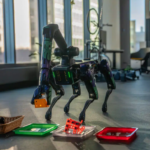
Other projects explore sustainability through new approaches to materials, construction and robot design. The Lab for Creative Computation investigates how robotic fabrication can work with irregular and reclaimed materials, while the CREATE Lab’s PAWS quadruped demonstrates how mechanical design and compliant materials can enable energy-efficient locomotion without continuously relying on motors.
According to the researchers behind the Sustainability Robotics manifesto, robotic systems should be minimally invasive, universally accessible and symbiotic—creating value not only for people and economies, but also for ecosystems.
As robotics continues to evolve, sustainability may therefore become more than a constraint or an additional design consideration. It could become one of the key performance metrics for the next generation of robots.